Winter Mint Buffet Before & After [your pick]

As you all probably know by now, mint is my favorite color… hands down.  So you can imagine my delight when Bridgett, from Osie Moats sent in her incredible before & after buffet transformation.  Bridgett took an outdated thrift shop find and revived it by finishing it in a minty gray/blue…ahh, a girl after my own heart! 

Here’s what Bridgett’s buffet looked like when she picked it up:


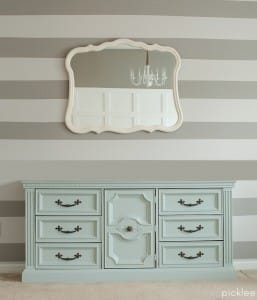
Bridgett chose this buffet to transform because the quality was great.  Although it had laminate material on the cabinet fronts, all of the drawers had beautiful dove tail joints…a key factor when selecting a good piece of furniture to flip!  She chose to paint the buffet in Frozen Pond by Behr, but before she did so, she primed the entire piece to be sure the paint adhered to the laminate material.  Here’s how the buffet turned out!

What an incredible transformation!  Look at the beautiful mirror and striped accent wall too!  Well done, Bridgett!

Here’s a close up of the hardware.  Bridgett made a great choice in keeping the original hardware, which has a great aged brass patina…

Cheers to another successful transformation!  Share your thoughts and rate Bridgett’s transformation below!

VN:F [1.9.22_1171]
How many pickles would you give this post?
Rating: 4.8/5 (17 votes cast)

Cure for the Winter Blues! [before & after]

It’s cold, it’s wet, it’s icy and dark…it’s winter in New England! Now that the weather doesn’t exactly permit flea markets and yard sales, I’m digging into my reserve for new pieces furniture to revive! Luckily, I collected and saved up a bunch of pieces over the Summer to keep me busy over this long, cold Rhode Island winter =) One of the pieces I pulled out was this antique spool leg table I picked up at a local auction…I decided I wanted to give it a bright & cheery beach cottage look, the perfect cure for my winter blues!

Here’s how the piece looked before it’s revival:

It’s a great looking piece with lots of character, but it needed a new life…without question.

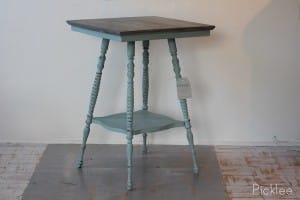
I started out by painting the entire table in Spring Hill Green, by CeCe Caldwell chalk + clay paint.  This would not be by final color, but I wanted a layered, distressed cottage look.

Next, I painted the table legs in CeCe Caldwell’s Alaskan Tundra Green.  I watered down the paint a bit to give it a bit less coverage, I wanted some of the Spring Hill Green to come through =)  Then finally, I chose to paint the table’s top and bottom shelf in Pittsburgh Gray.

The last step when using CeCe Caldwell’s chalk + clay paint is always to wax or satin finish your piece.  However, before waxing, I decided to use a fine grit sand paper to distress the table around the legs and edges.  Once I got the table where I wanted it, I gave it a good coat of wax!

Here’s how the finished spool leg table turned out!


There may not be a permanent cure for the winter blues, but this happy little table certainly brightened my day =)

Share your thoughts and rate this transformation below!

You can find this table available for purchase at Picklee on Spring!

VN:F [1.9.22_1171]
How many pickles would you give this post?
Rating: 4.5/5 (17 votes cast)

The Willy Wonka Chair Transformation [before & after]

I absolutely love antique chair transformations.  Each and every transformation is beautiful and unique in it’s own way, but the feeling of sheer bliss it gives me to marvel at the finished product never changes.  Finding the perfect chair to transform feels like winning the lottery to me…my heart begins to race and I feel dizzy with excitement (you might think I was talking about something else entirely ;) )  That was the case when I discovered this wonderful antique Louis XV Rococo chair at a flea market a few months back.  It sat there in the flea market booth, it’s fabric torn to shreds and it’s stuffing ripped apart, the wood frame covered with dings and chips…an eye sore on it’s best day, but I could picture how this chair once looked in it’s glory and I felt compelled to bring it back.

You should know that unfortunately, I lost a camera full of images so I don’t have the exact “before” picture of the chair.  I did however find a similar photo of a Louis XV Rococo chair (in much better condition), just to give an idea of how this chair started out…

The fabric on my chair had a similar pattern, but it was no longer in tact, which made the task of ripping off the old fabric much easier than usual =)

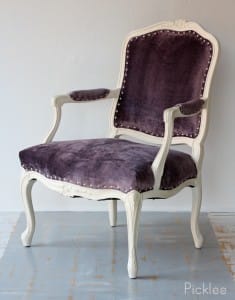
As always, I saved the old fabric pieces to use as templates for cutting out the new fabric.  It took me a while to decide on a look for this chair…The antique Louis XV chairs were made to make a bold statement, so I knew I wanted to carry on that look.  I decided to brighten up the chair’s frame using CeCe Caldwell’s chalk + clay paint in Vintage White.  After two coats of paint, I used a damp cloth to lightly distress the edges giving the chair a more “aged” look.  Next, I applied a coat of CeCe Caldwell’s clear wax for protection.  For the upholstery,I decided to use an eggplant colored brushed chenille fabric.  Chenille is one of the tougher fabrics to work with when upholstering because it’s less pliable, but the look is absolutely stunning.  After I finished upholstering the chair, I added silver nail head trim to give the chair a chic twist.

We now refer to this bold beauty as “The Willy Wonka Chair” because of it’s signature eggplant color =)


You can find the Willy Wonka Chair available for purchase at Pickee on Spring and also in our Etsy shop!

VN:F [1.9.22_1171]
How many pickles would you give this post?
Rating: 5.0/5 (7 votes cast)

Coastal White Cane Chair Revival [before & after]

In the great big world of furniture, one thing you really don’t come across much anymore is caneCane furniture was really popular years ago, but it seems like it’s slowly becoming a lost art….likely due to the skill and amount of time it takes to weave a single piece of cane furniture.  This is why I get so excited when I come across a beautiful piece of cane furniture in pristine condition, I can only begin to imagine the amount of time and effort put into these pieces.

On a recent antique expedition, I came this fabulous solid cane arm chair.  I had an instant vision to brighten it up and bring it back to life.  Here’s how the chair looked when I found it (my apologies for the quality of this photo, it was taken in the shop right before I rushed home with the chair!)

When I got the chair home, the first thing I did was give a a nice coat of CeCe Caldwell’s Simply White paint chalk + clay paint.  This paint did a wonderful job adhering to the cane, which I was a bit worried about to start.  I ended up with two coats of paint on the chair, then I sealed it with a coat of spray lacquer.  I wanted the chair to have a solid, glossy finish.

Next, I decided the chair needed a cushion.  So I used a sheet of cushion foam and traced the shape of the seat, then cut it out.  To make the cushion, I traced the shape with fabric, then sewed it together similarly to how you would make a pillow (inside out, then attached piping to both sides). 

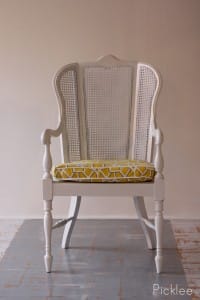
I love my cane chair’s new coastal cottage vibe, it will be loved for many, many more years now =)


Isn’t she a beauty?


I’m loving the gate patterned fabrics right now =)

You can find this chair available for sale at Picklee on Spring!

VN:F [1.9.22_1171]
How many pickles would you give this post?
Rating: 4.3/5 (9 votes cast)

Farmhouse Wide Plank Floor Made from Plywood! [DIY]

As many of you know, it was just two short weeks ago that we opened the doors to the Picklee shop in Newport, RI! Getting the shop ready was a super exciting (and stressful!) process.  We were faced with a stinky, old, run down storefront that had been neglected for YEARS, but we had big plans to make the shop a beautiful place.  Sort of like reviving a stinky old chair…but on a much larger scale ;)

We fell in love with the space because it was in historic home built in the early 1700′s, so it was packed with original details and character…oh yea, and it was in the heart of the Newport waterfront shopping district =)

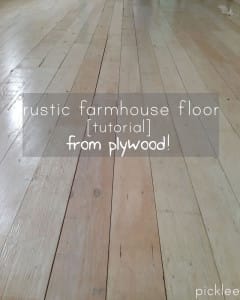
When it came time to renovate the shop, one of the first projects we took on was the floor.  The shop came with a Berber carpet that was probably three thousand years old…OK, maybe not that old-but it sure looked and smelt like it.  We knew we wanted to bring in beautiful & unique flooring that kept the shop true to it’s era, and save on costs at the same time.  We tossed around ideas for a while, and then eureka!  We decided we would create a wide plank, farmhouse style flooring using good ol’ fashion PLYWOOD!  Sounds a little crazy right? That’s what the guys at Home Depot thought too…just wait until I march back in and show them this!


plywood-floor-tutorial 

I am absolutely thrilled with how beautiful the Picklee shop’s plywood floor turned out!  Its classic and true to the age of the space with it’s wide plank style, yet has a coastal farmhouse feel with it’s rustic look and white-washed finish.  I’ll to show you exactly how to get the look by making your very own wide plank plywood floor!

First, I head over to my local Home Depot to scope out the different types of plywood.  I chose to use standard 1/2″ thick 4′ x 8′ sheets at a cost of just under $20 each!  I opted for these because they wern’t perfect.  They had knots, markings and lots of color variations…this was exactly the look I was going for!

With (lots of) help from the guys at HD, I loaded up my cart with the plywood sheets.  I needed 14 sheets since I would be covering an area of just under 450 square feet.  My original plan was to bring the sheets home and convince my lovely fiance to cut them into into planks for me, but then a miracle happened…the wonderful man at HD offered to cut them all for me!

In order to have zero waste, I chose to have the boards cut into 8 inch by 8 foot lengths, giving me six planks per sheet of plywood.  Thankfully I picked a slow time of day to go to HD because it took a little over an hour (and two trips to the shop and back) to cut all 14 sheets.  I am so grateful to the guys at Home Depot, even though they looked at me like I had 10 heads when I told them my plan for the planks ;)

Once the planks were cut, I brought them into the shop and laid them out.  First, I took out an electric sander and sanded all rough edges and splinters.  Next, I made up a mixture of 1/4 CeCe Caldwells Simply White Chalk Paint and 3/4 water.  You can alter this mixture depending on how “white” you want your flooring.  I used a roller attached to a broom handle to apply a coat of the white washed paint to all of the planks.

This next step is where my lovely fiance came in…some days I just don’t know what I would do without him =) First, Brett applied Bostik flooring adhesive to the backs of the plywood planks.  Next, he laid them into place then used a finish nailer to secure them to the floor.  We were lucky enough to have a strong wood sub-floor to shoot the finish nails into.  Brett used 1 1/2″ nails and shot them in on an angle.  We chose this method because we wanted the floor to have that rustic look.  The nails were spaced out about every 12″, placing two all along either side of each plank.


It’s important to have spaces in between the planks because wood will shift and expand over time.  We found that a metal straight edge gave the perfect distance between planks, so Brett used that as a spacing guide.


As Brett went on nailing down the boards, he used a table saw to cut some of them into different lengths so that we would give the boards a staggered look.  You can see some of the shorter lengths above…

See I helped a little here, passing him the pieces ;)

Once the entire floor was down, about 6 hours later…we applied three coats of Minwax Polyurethane (in satin) to give the floor a protective finish.  We waited 24 hours in between the first two coats, then only 2 hours between the second and third coat. Less than $300 and a day later, the floor was complete!  I couldn’t be more happy with the results =)

Sheer bliss….

**UPDATE!**

Here’s a photo of the floors inside the Picklee on Spring shop, 4 months after the install!  They are holding up wonderfully and we receive compliments daily!

I’ve had lots of questions about how to calculate square footage needed, here’s how…

Each sheet of plywood it 4′x 8′ (32 square feet). Simply divide the total sqaure footage of your space by 32 to figure out home many sheets you’ll need. Then just add an extra sheet or two for scraps!


VN:F [1.9.22_1171]
How many pickles would you give this post?
Rating: 4.9/5 (442 votes cast)

The Farmhouse Chic Cow Print Stool [before & after]

I’m usually pretty conservative about using crazy prints and fabrics on my furniture revivals.  Don’t get me wrong, I love a vibrant, poppy print, but I usually like to maintain a classic look with more subdued colors.  This is the reason I get super excited when I have a small scale piece to work with, like a little chair or a stool.  I’m always more daring when it comes to fun prints on smaller pieces.  I came across the perfect opportunity to do this when I picked up this great antique foot stool at an estate sale a few weeks back.  It was in rough shape, but I loved it’s classic look and intricate detail.  Here’s how the stool looked when I found it:

Not really much to look at, but check out the great detail on this little piece!  Quality, character & detail are the three main things I look for when I’m searching for pieces to revive and this definitely fit the bill.

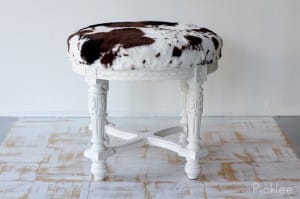
I decided to give this dated antique stool a chic farmhouse twist, so I chose to upholster it in a super-plush cow print fabric!   After removing the old fabric, I painted the stool in CeCe Caldwell’s Vintage White, then added new foam to the seat and finally finished with my funky cow print fabric!  I love the way this cozy little stool turned out!

What do you think of this bold farmhouse stool? Is this plush cow print fabric is too much or just right?  Share your thoughts and rate below!

This stool is available for purchase at Picklee on Spring!

VN:F [1.9.22_1171]
How many pickles would you give this post?
Rating: 4.5/5 (18 votes cast)

Louis XV gets a major overhaul [before & after]

Happy Thanksgiving Eve, everyone!  I wish I had something “Thanksgiving-ish” to share today…but I don’t!  Instead, I bring you the story of a sad and tired antique Louis XV chair (much more fun in my opinion ;) )  I came across this old, tattered chair a few weeks ago on my street believe it or not!  Someone had actually set this antique out to be sent to the dump!  I can understand their thinking given the condition of the chair when I found it.  The upholstery was torn apart, the wood full of dings and chips; it seemed helpless…but not to me!  I grabbed the chair and brought it straight home.  This antique Louis XV chair (one of my favorite chair styles) was beautiful in it’s day, and it was my mission to save it and turn it into something amazing again.

Here’s how the chair looked like when I picked it up:

The first thing I did when I got the chair home was to repair the wood where it had been dinged, dented and chipped. I used wood filler, let it cure and then sanded it down.

Next, I carefully removed all of the upholstery, making sure to keep it in tact so that it could be used as a template for the new fabric. This process was far from a walk in the park.  I’m talking about  hundreds of nail heads and tacks, never mind the decades of funk that had accumulated under the fabric…YUCK

Once all the fabric was removed, I noticed that the chair was a little wobbly in spots, so I reinforced those areas with clamps, wood glue and a nail gun.  This is where Brett comes in and makes my life a little easier with his handy tools ;)

Now the chair was ready for it’s paint job!  I used a two coats of CeCe Caldwell’s Simply White chalk + clay paint on the chair, followed by two coats of CeCe’s satin finish.  This gave the chair some depth and a silky smooth finish.  I’m a big fan of using lighter colors on detailed pieces, I think it really helps accentuate the quality of workmanship and ornate carvings.

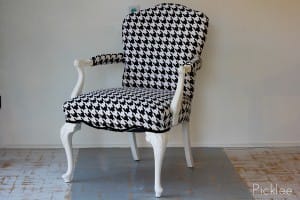
Last, I used the old fabric pieces to trace templates for the the new upholstery on the chair.  I chose to use a big, bold black & white hounds tooth fabric.  I love hounds tooth right now, it makes such a statement, especially on a beautiful antique piece like my Louis XV chair.

I good 6 hours later (these things are time consuming, but SO worth it ;) ), I’d completed the hounds tooth upholstery on the chair.  The last step was to line the exposed areas with black trim.  I used fabric adhesive to apply the trim.

Finally, this tired old Louis XV chair was finished with it’s transformation!  Here it is!

I’d say that my mission was successful!  One more time, here’s the “before & after” transformation shot…

What do you think of this chair’s transformation?  Share your throughts and rate it below!

You can find this chair available for sale on pickleeonspring.com!

Have a safe & happy Thanksgiving, everyone!

Gobble, gobble ;)


VN:F [1.9.22_1171]
How many pickles would you give this post?
Rating: 4.7/5 (23 votes cast)

Queen Anne Keyhole Dresser {before & after}

I just finished up another great piece, I am so excited to share with you all!  I picked up this beautiful antique solid oak key hole dresser the other day.  It was one of those moments when I looked at it and instantly fell in love; I had an instant vision for its’ destiny!  Of course I used a blend of my favorite CeCe Caldwell chalk + clay paints to revive this piece.  Here’s the Queen Anne Dresser transformation from start to finish!

My first step in this transformation was to mix up the perfect color for this gorgeous piece.  I chose to use a mixture of CeCe Caldwell chalk + clay paint, I blended approx. 1/4 Destin Gulf Green, 1/4 Kentucky Mint, and 1/2 antique white until I reached this silky blue/green.  I used a heavy dry brush technique to achieve an aged-looking finish.  Dry brushing is simply applying a lighter, more whispy coat of paint (rather than using a heavy hand).

Once a got the dresser looking just how I wanted it. It was time to work on the hardware.  I knew I wanted to use the original hardware because it was so unique.  The brass pulls were so ornate and delicate, but they definintely needed some revival.  I used my Ruff n’ Buff in Gold Leaf to shine up the dull finish.  This stuff is so simple to use, and the transformation is amazing!

Here’s the difference between the old and new hardware after applying the Rub n’ Buff…

Wow.  I love that stuff!

After the hardware dried, I reattached it to the dresser.  I applied a good coat of CeCe Caldwell’s clear wax, then finished it off with buffing pad to give the piece a silky smooth finishing, here’s some close ups…

Look at those legs!!


Here’s a great detail shot of the dry brushed, vintage looking finish…

There’s that fabulous hardware again!

What do you think about the transformation?  Share your thoughts and rate below!


VN:F [1.9.22_1171]
How many pickles would you give this post?
Rating: 4.8/5 (37 votes cast)

The Vintage Fan Restoration [before & after]

Every so often, the stars align just right and I’m able to convince Brett to come along with me on a flea market trip.  Generally, he enjoys those types of things (not as much as me, but enough ;) ), he just gets too busy and forgets!  On a recent trip, we stumbled upon this awesome vintage Kenmore fan.  I think these things are great, I just won’t normally buy them because I’ve got pieces of furniture on my mind.  I was glad Brett tagged along because he convinced me to pick up this fan, and promised he’d take on the restoration, fine by me!

Brett did a fabulous job documenting his transformation.  He first shared it on his blog, DailyMilk, now we get to enjoy it!

We’ll start with the before and after of the fabulous vintage Kenmore fan transformation:

Pretty amazing transformation, huh? Brett did all of this using plenty of tools, a ton of patience, and good quality spray paint!

In order to properly restore the fan, Brett decided to completely disassemble the whole thing.  He wanted it perfectly restored and painted.  The first thing he did was remove the fan cover by taking out a screw on the back of the fan. The cover slid right off to reveal the motor and brackets holding it in. Before he got into cleaning the inside he figured it might be best to remove the fan cage too. He pried the cage off with a screwdriver, cleaned it, and set it aside. Brett thoroughly scrubbed and cleaned every part and every particle of dust with antibacterial cleaner.

Next, Brett removed the fan blade by squeezing an Allan wrench between the blades.

Brett then removed the entire motor. Mainly because he wanted to paint the fan shaft gold, the same color as the fan blade, without getting paint all over the black motor body. Also, since this fan was so old, it had all kinds of dust and grime stuck to the motor and vents, which you could also smell…this absolutely needed to be addressed!

When it came to cleaning the grungy brass “Kenmore” plaque Brett first assumed he’d have to go out and buy brass cleaner.  Then he figured there must be another solution on Google; sure enough, he found a fer great options. What he chose for an easy brass cleaner alternative was good ol’ worcestershire sauce!  He used an old toothbrush and scrubbed the brass with worcestershire until it was clean. It worked really well!

To prepare the fan for it’s paint job, Brett taped up the newly cleaned brass.  He first traced it with a pen to make sure it fully adhered to the brass, then trimmed it with a razor blade.

Now that all the parts were separated, Brett used gloss black spray paint on the fan body, and gold metallic on the blades.  Three coats of paint later, the fan had dried and it was time to put it back together!

What a wonderful transformation!  I’m so glad Brett took this on too, he’s already itching for another one…I can see why, the results are incredible!

This fan fit perfectly on my newly revived industrial modern desk too!

What do you think of Brett’s fan?  Share your thoughts and rate it below!

VN:F [1.9.22_1171]
How many pickles would you give this post?
Rating: 4.5/5 (20 votes cast)

Restoration Hardware Inspired Art Deco Desk [before & after]

It’s been a bit since I’ve shared one of my own before & after furniture transformations…ironically, I seems that I’ve been working on nothing but furniture lately, I’ve just been so busy with it that I haven’t found the time to share with you all!  I’m breaking the steak today with an awesome mid century, art deco desk that I revived using a mixture of CeCe Caldwell’s Vermont Slate, Antique White, and gold metallic.  I formulated this mixture with inspirations from Restoration Hardware on my mind. 

The beautiful curves and mid-century design of this desk were absolutely ideal for the industrial modern transformation I had in mind.  Here’s a before photo: (you’ll have to forgive me here, I recently lost a camera full of images so this isn’t the actual before, but it’s very close look-a-like!)…


After a coat of CeCe Caldwell (my favorite all natural chalk + clay paint!) in Vermont slate and a wash of Antique White & Gold, here’s how my Restoration Hardware inspired mid-century desk turned out:


My first step in the revival  process was to remove the hardware and give the desk a thorough cleaning.  I wans’t going to use the original hardware, but after giving it a good cleaning, I loved the gold patina that came through.

Next, I gave the desk a good solid coat of Vermont Slate chalk + clay paint. 

After that dried, I mixed up a wash of Antique White, water, and just a bit of gold metallic.  I lightly covered the entire piece in the wash.  Last, I used a damp rag to ever-so-slightly distress the desk.  This is just one of the beautiful things about chalk + clay paint, you can distress with simply water (rather than tirelessly scratching away with sand paper).  Once I got the desk where I wanted it, I gave it a good coat of CeCe Caldwell’s clear wax to finish it off.

This now industrial modern desk turned out exactely how I’d wanted, I couldn’t be more pleased with it!  Check out the great industrial desk chair and revived vintage fan too (look for their before & after’s, coming soon!)

Stay tuned! This desk and many more fabulous pieces will available to purchase soon!


VN:F [1.9.22_1171]
How many pickles would you give this post?
Rating: 4.5/5 (12 votes cast)